
Just as promised, we are giving you a detailed review of our proven family board games with our Board Game Review Series. Since we have so much time entertaining ourselves with these games, we are more than happy to share the vibe with you.
And for our first board game review, we are going straight with our top favorite deception game:
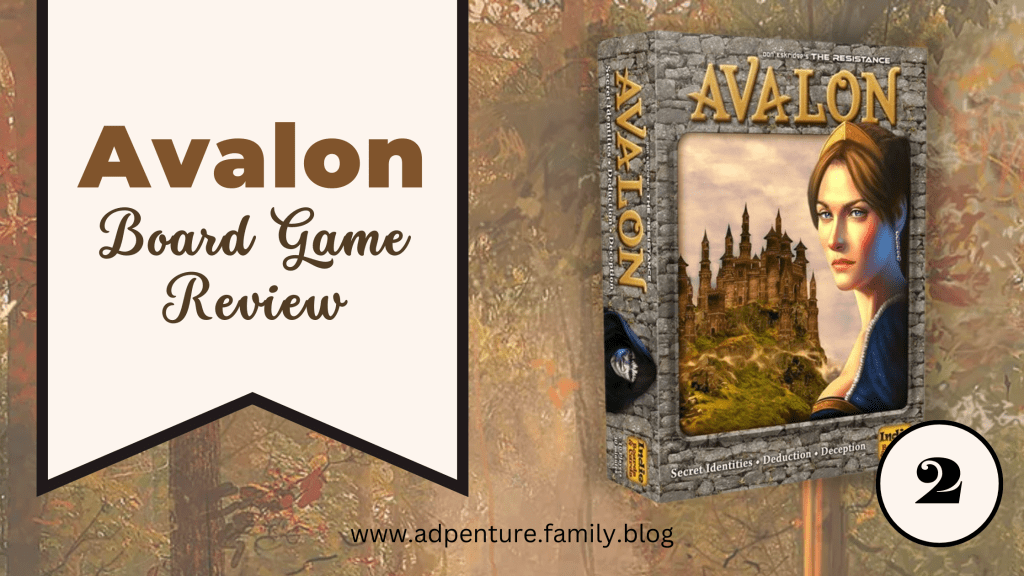
Game Overview
Avalon is a social deduction game with special roles that can be played by 5-11 people (or even more). It is, what I believe, a perfected version of The Resistance with its special characters and twists in the quests.
It is a battle between two teams: (1) the loyal servants of King Arthur and (2) the minions of Mordred; or we as we liked to say, the “good” and “bad”. It is a perfect game of deception where players do not know each others’ characters and have to determine who they should believe.
Both teams have the same goal, to enter the quest and win the game. To do it, however, is a bit different for each team. Only the Minions of Mordred know who their team members are. This advantage gives the minions the chance to lie and deceive the Loyal Servants into letting them be part of the quest and cause it to fail.
Players can discuss, accuse and make a vote to put their bets on each quest. The win goes to either of the team who completes 3 out of 5 quests; the Loyal Servants for “success” and the Minions for “fail”.
What’s in the Box
Unlike other games, Avalon does not need a large board in order to play. It consists of:
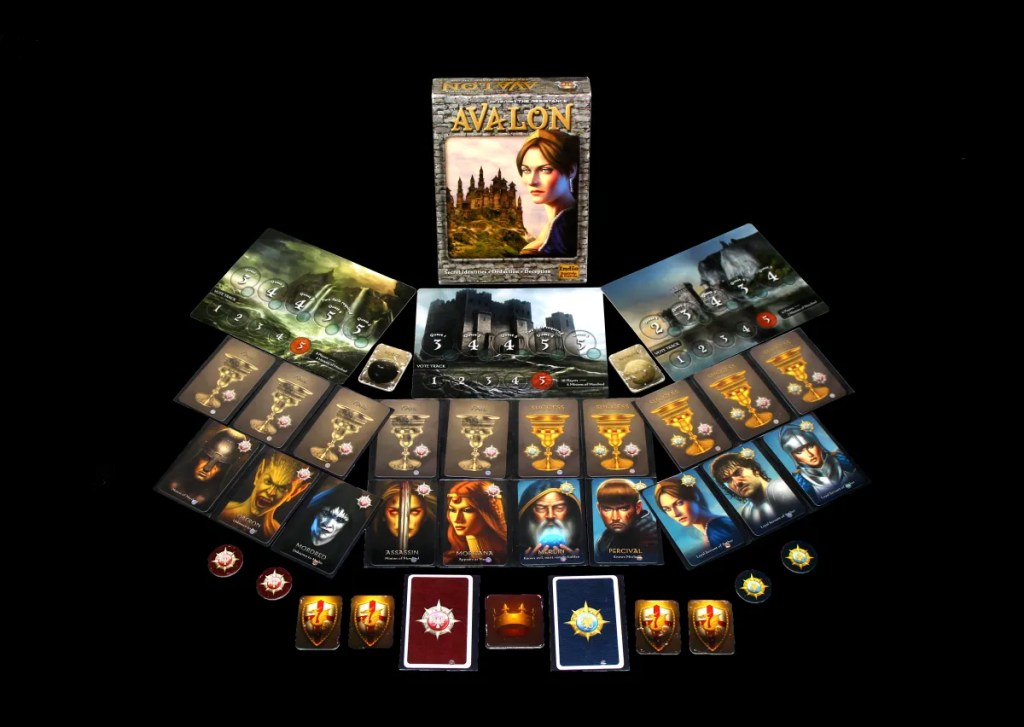
| 10 character cards (with 7 special characters) | 5 quest markers |
| 10 success & fail cards | 1 crown token |
| 1 inquisitor token | 1 vote track marker |
| 5 shield tokens | 1 lady of the lake |
| 20 vote tokens (approve & reject) | 3 score tableaus |
Set-Up
Avalon is just as easy to set up as its sci-fi sibling, The Resistance. All you need is a table, space for your players to sneakily peek at their cards, and maybe a dim light to set the mood. We usually let everyone look at their role card and then hide it somewhere—under a napkin, inside a hoodie sleeve, or just flat on their lap (no peeking, obviously).
Place the quest tableau in the center, add the round marker on Quest 1, and stack the score tokens, team tokens, and quest cards nearby. Each player gets a secret character role card (which might include powerful figures like Merlin or Morgana) and a pair of vote tokens—Approve and Reject. The number of good and evil characters varies by player count, and the handy play guide that comes with the game tells you which roles to include. Simple, but sneaky.
How To Play
The game kicks off with the “Narrator” reading the night phase script. This is where players close their eyes and the Minions of Mordred open theirs to recognize their teammates. If you’re using roles like Merlin or Percival, they’ll also peek at specific people. It’s the most tense “close your eyes” moment you’ll ever experience—equal parts suspense and trying-not-to-laugh.
The Teambuilding Phase
Once eyes are open, the game begins. The narrator gives the Leader token and Team tokens (based on the current quest) to a player, who becomes the first Team Leader. This leader chooses who goes on the quest, and everyone votes on the team. If the majority says yes, you move to the quest. If not, leadership passes clockwise and a new team is proposed.
This is where the mind games start. Evil players (Minions of Mordred) have to pretend they’re Loyal Servants, while the good guys are desperately trying to read people’s facial expressions like they’re in a detective show. If five team proposals are rejected in a row—game over. Evil wins.
The Quest Phase
The approved team each gets a pair of quest cards: one for “Success” and one for “Fail.” Loyal players must play Success, but evil players can choose. All cards are shuffled and revealed—if there’s even one Fail (or two, depending on the quest), the mission fails. Cue the panic. Cue the finger-pointing. Cue someone yelling, “I KNEW IT!”
Playthrough Reflection
We picked Avalon for game night because, let’s face it—we were in the mood for deception and dramatic monologues. Seven of us sat around the table, instantly suspicious of each other before we even opened our eyes. We assigned roles, dimmed the lights, read the script, and suddenly I was a Loyal Servant of Arthur, staring into the abyss of not knowing anything while the evil team already had the upper hand.
Quest 1 was smooth—too smooth. No fails. Of course, that just meant the traitors were lying in wait.
By Quest 2, the peace was shattered. One fail, and suddenly the entire table was in an uproar. Someone got defensive, and another got suspiciously quiet. Quest 3? Total meltdown. Two fails. Even I started accusing people at random, and I was on the good side!
When we finally won the last quest, the good team erupted in celebration. But then… came the Assassin.
All that Merlin had to do was hide. Just one more step. But nope—our Assassin friend stood up with theatrical flair, pointed across the table, and said: “You’ve been a little too quiet tonight.”
Boom. Nailed it. Evil won. Cue the heartbreak and stunned silence.
Final Thoughts
Avalon takes everything great about The Resistance and layers it with legend, drama, and some really brilliant role dynamics. It’s an absolute blast for players who love strategy and psychology, but it’s also easy to learn for newer players. If you like games where trust can be a weapon, and betrayal feels oddly satisfying, Avalon might be your next favorite.
Just… don’t play it if your friendships are already hanging by a thread


 Adpenture
Leave a comment